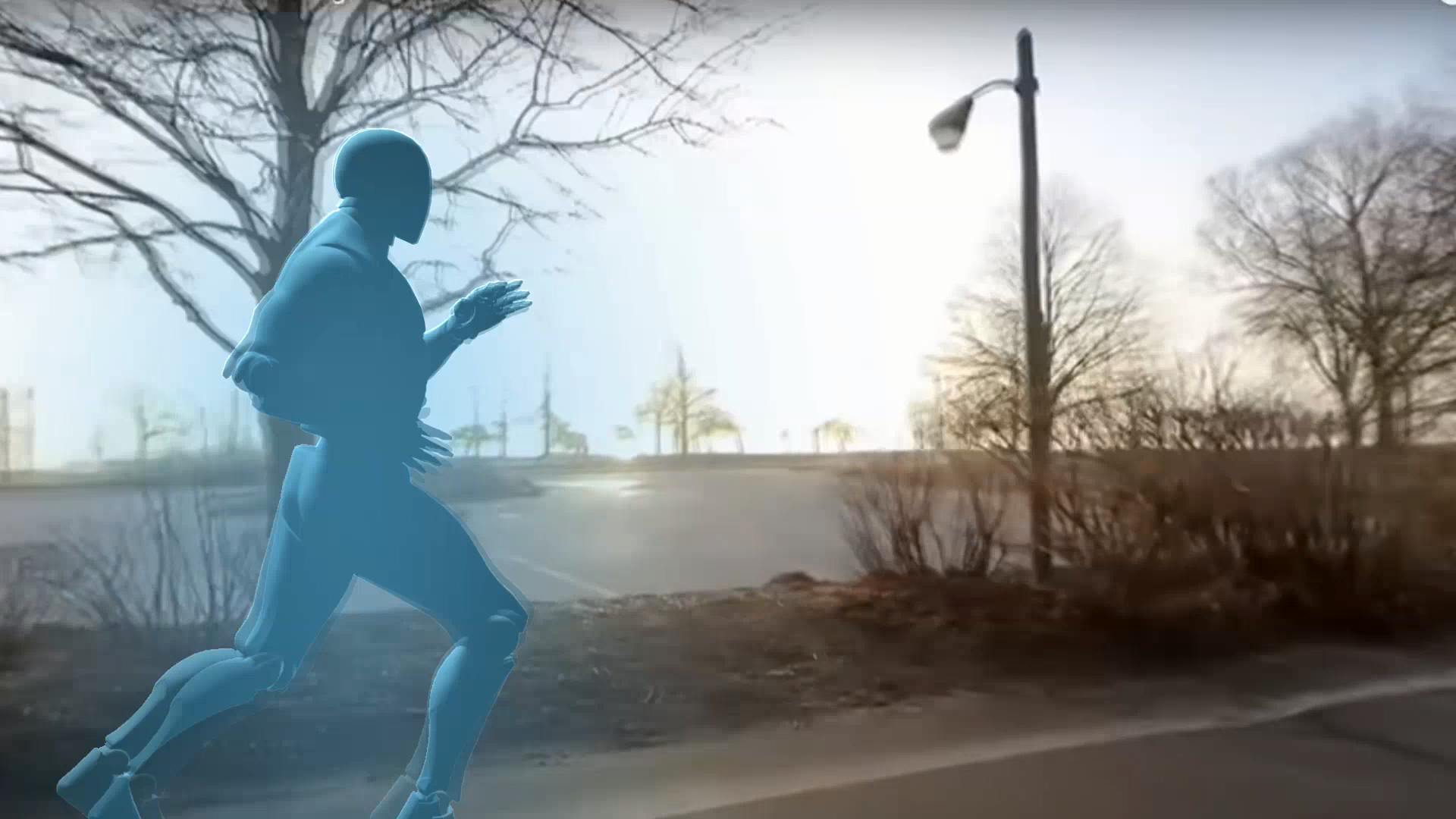
This project was done as part of the human-centered product development course and under the supervision of Maija Hautere, usability specialist at polar. Our goal was to increase the overall health being of individuals with the help of wearable technologies. self-tracking mainly focuses on objective measurements. however, we came to realize that subjective evaluations of progress, goal striving, goal attainment, and general health are also essential when assessing overall well-being. we used the human-centered design approach to gather as much information as possible about our end-users and further reflected that in our design decisions.
9241-210:2019 Ergonomics of Human-System Interaction
Ergonomics of human-system interaction was one of the main ISO standards that we utilized in our project. This standard documentation lays out a framework for human-centered design projects. It explains steps on how to take users’ needs and environments into account in the design process. For example, not only focusing on the usage part of the product lifecycle but also acquisition, storage, and disposal of the product. It instructs designers to make decisions based on user evaluation data.
This standard acts as a reminder for us to think about responsibilities like safety & health, as well as accessibility. As our solution will be a sort of XR metaverse, there will be people who are not connected to it. We need to consider how non-users will react when a user is talking to an invisible hologram in public. Also, how do we make sure that dangers and obstacles are given proper attention? As for accessibility, how can blind people access the metaverse?
From this standard, we’re using especially the iterative design model, and tips on driving design based on user feedback.
By using wearables such as a thermal vest, we need to make sure no hazards can be caused by them. When manually controlling the vest through our brain interface, we must prevent crossing critical boundaries in temperatures. (TOSSED OUT FEATURES)
Brainstorming
This first step was the ideation session. in this step, we identified key values for the user and how we should deliver these values. along with creating a trend map, we get to realize what technology should be used primarily for our purpose. After carefully considering the users’ needs and expectations, SIA(Self-improvement assistant) was born. An assistant that can monitor your health status and improve your overall well-being while updating you with the latest training methods.
Power/Interest Grid
At the early stages of the product development, We identified primary, secondary, and tertiary stakeholders and categorized them using the power/interest matrix. It is crucial for us to see who has the most interest in our project and is likely to influence it.
Customer Segmentation
To better know our targeted users, we grouped them based on common characteristics. Our primary user groups were highly stressed people, athletes, and content creators.
Background User Research
In the first round of interviews, we tried to pitch our idea to the users in order to get early feedback about the product’s idea and how people will utilize this technology in their everyday life.
First demo video created for the background user research and MVP validation (1st & 2nd round of interview)
At first, we started by explaining the concept and the interview purpose. Afterward, we proceed to interview questions.
Concept
We’re in the future, 10 years from now. Roughly described, this product is a metaverse application. The users can access the metaverse through Extended Reality contact lenses. Users can consult an AI-based SIA (Self-Improvement Assistant), helping the user with their daily routines and choosing healthy actions. Users can also see their friends as holograms if they join the same “session”.
Interview purpose
I will ask questions related to different factors of well-being, to figure out the areas of life that are most in need of a solution. Some of these factors are social life & relationships, physical health, mental health, and financial health. I also directly ask questions about some features we already came up with.
Interview question
Experience with wearables, which ones?
Experience with XR (Virtual Reality, Augmented Reality, MR)
If you had a busy day, what would it contain and how would you plan/schedule it?
What kinds of things motivate you to do routine tasks?
What encourages you to be the best at what you do?
How do you take care of your mental health?
If you do physical activity, why do you do it? Does exercise mean getting into shape or is it also related to your mental health? Or What is your motivation to stay active?
Have you had any coaching, either in sports or other areas of life? Positives/negatives about it?
Describe an ideal coach /personal trainer for you – a talkative one or straight to the point?
If you’ve used any wearables (smartwatch, heartbeat sensor, sports tracker), what do you like about them?
Here is where we show the demo videoWhat would you think about having a Virtual AI like Sia watch & analyze your life and give guidance on any skill or area of life? Where would you apply this?
Would you be worried about privacy?
What would you prefer about the virtual assistant’s appearance? (Should it be visual or just audio?)
Is a different appearance suitable for different situations?
1st Interview Analysis
In the first round of interviews, information was mostly related to the user’s demographical background as we were trying to understand our targeted users and their characteristics better. however, here I will only highlight findings that were related to the main concept of the product
Privacy was the biggest concern of the interviewees. Many people like the idea of having an assistant throughout your daily life to help you track your tasks while watching over your physical and mental health being. however, they mentioned that they feel like they don’t have control over their life if the system is in charge of every decision-making.
When asked about their ideal coach's character, all participants mentioned that they wanted a coach that is not afraid to point out mistakes and is talkative rather than silent. an ideal coach would be able to customize your regimen based on your needs. they should also be knowledgeable about their craft.
When asked about what their goals are for improving themselves, participants talked about their sense of accomplishment and how that makes them look, in the eyes of other people.
when asked about the preferred appearance of the virtual assistant, all participants said they would prefer to have faced as it would create a better connection than just voice communication.
Persona
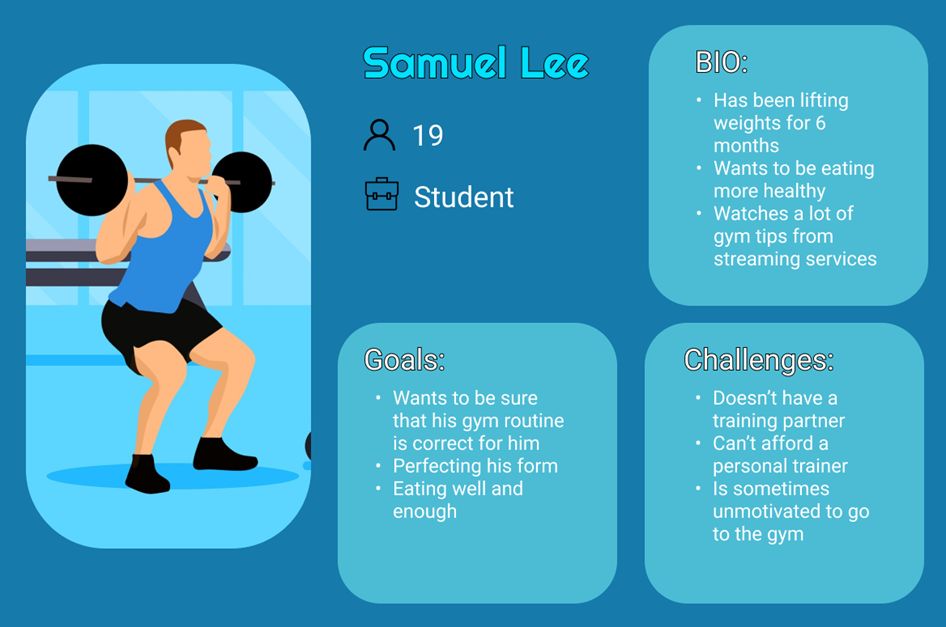
Results and experiences from the ideation session
For ideation, we have mainly used brainstorming, and this has worked the best in generating innovative ideas. In addition, we have used rapid prototyping in the form of a story script and a demo video in order to clarify our thoughts to both interviewees and the group members themselves. The story script was supposed to be a video at first, but it played out as a good method to just imagine a use scenario for the SIA feature. The demo video was basically our first MVP.
We started the brainstorming in Mural. We put notes on any ideas we could come up with. We were getting so many ideas that it was hard to confine them to a few of the most key features, but we managed to bring it down to three key features.
We selected the SIA (Self-Improvement Assistant), social holograms, and environment modification as the primary features because we feel they feed into diverse types of well-being. SIA will assist the user in mundane tasks and organization/scheduling, reducing the mental burden of having to do that all by themselves. Also, having SIA to be able to show example exercise repetitions at the gym will help the user to improve much faster and reduce chances of injury – both positively affecting well-being.
Social holograms will give people more chances of socializing. Being able to jog with your training partner regardless of physical location is a big quality of life change. It is especially useful in a time of pandemics.
The environmental modification stems from the cruel-looking concrete jungles and the darkness of winter. Changing one’s environment to a more tropical one in the polluted city center or showing virtual sunshine during dark winter days will give the user a chance to feel more energized and less stressed.
Ideation sessions strengthened the group members’ vision of the product and made sure that we were all thinking of the same concept. They allowed each group member to pitch their innovative ideas to be added to the concept.
Wireframes
In this section, we mapped out the most interesting features. It has many features that we'd like such a product to have, but we dropped out many of them for the sake of simplicity and staying within the bounds of wellbeing.
XR Contact lenses – we can use both AR/VR with them
Possibility to look at data and hi-fi replays
Metaverse – will be able to see holograms of other users around the world, and be able to change the current environment outlook
Share your current environment with others (Use suit’s obstacle detection and camera from XR contact lenses)
Suit – haptic feedback. Can detect obstacles. Acts as a controller. Has an airbag for safety measures.
Input modalities – mind control, gloves, gestures, eye gaze, vocal input. AI learns from users' actions and how they want to control them.
Output – visual, haptic, aural
Indoor navigation – visually impaired people can sense things around them.
Self-Improvement assistant.
Holographic avatars training
Use cases
Therapist/Friend/social worker
Helping with workout goals/ Competitions, training mode, competition
Scheduling
Help with tasks, chores, and fixing things
Teaching and training
First Draft
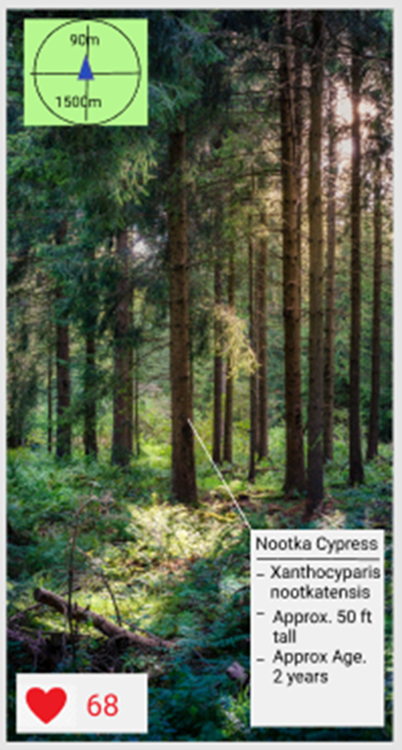
An information mode where if you hold your gaze for 5 secs, it will give you more information about the object of your gaze. To narrow the information obtained there can be sub-modes to choose the kind of information you will be looking for, e.g., plants, cars, and animals to trigger the AI to search only for the chosen section for the duration of the walk. To further improve the simplicity the user can check settings on the information about the thing they would want to see e.g., age of tree, car, make, type because the field of vision is limited. We could also add a specific model or get information on only if the model is a BMW or something, or if the tree is a pine tree.
It will also measure heart rate.
The map on top of the screen shows how thick the forest is, for walks in the forest. It can switch to the length of the river or sea, depending on the settings you have put.
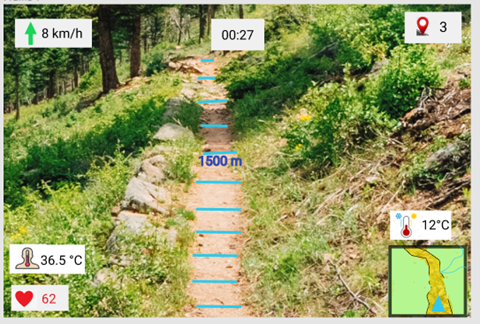
This would be a workout mode, from the top, left to right, the icons are:
The number of friends online
The number of milestones reached for the sessions (it could be a user set milestones mark for every 500m)
Heart rate monitor
Timer
The map
Some of the information can be hidden until the gaze activates them to reduce the noise while running, the map and timer can persist throughout the jog, but the others can be activated with an eye gaze to that position. This is to reduce noise in peripheral vision.
Value Proposition Canvas
We have used value proposition canvas to map each feature to the user’s needs and further ensure our product success.
User Story Mapping
Looking at roger's bell curve (Technology adoption life cycle), our first users will be early adopters who include people who are willing to purchase any newly launched product at the early stage of development. For this user group, we should develop the product in a relatively short time and add some features that create value for them. َfter listing all the features that we think should be included in the final product, we draw a line indicating what features are a must and should be included in the early version of the product before releasing it.
Features that are above the red line are the ones that need to be included in our MVP. Every user will start with choosing the sport they are interested in. they will be provided with learning materials to help them through their journey. SIA will show them 3D replays of the performances and reward them to encourage them. It will also count your calories and control your diet. These features are considered the very basic features of the product; without them, our system wouldn’t be usable and would not deliver any value to the user.
Storyboards
Now that we have a clear image of our product and we have gathered enough information about our users and their needs, it is time to validate our MVP. for that, we have created a hypothetical scenario along with four storyboards that demonstrate various use cases in different contexts.
MVP Validation
FeelGood Metaverse
A metaverse application that includes a personal AI assistant (SIA) that g. Observed through Extended Reality Goggles or contact lenses, FeelGood metaverse can also modify the environment to the user’s liking. We have the ability to see other users as holograms and interact with them, regardless of their physical location.
show demo video
show and explain storyboards
ask questions
Questions:
General
What would you think about having a Virtual AI like Sia watch & analyze your life and give guidance on any skill or area of life? Where would you apply this?
What would you prefer about the virtual assistant’s appearance? (Should it be visual or just audio?) Is a different appearance suitable for different situations?
Positive
Which features did you like the most? How could we make them even better?
How would you feel about talking to a hologram invisible to others?
Do you have a feature in mind that you could add to such an app?
Negative/constructive
We understand there are privacy problems with technology like this. Assuming these are taken care of, are there other negative sides that come to your mind?
Which feature(s) would you not use? Why?
Results from MVP Idea Validation
We had five participants in the MVP idea validation.
Appearance
Customize the personality/appearance of the coach in different situations
SIA can just be a voice, it doesn’t always need to be visual
Positive:
More opportunities for social interaction
virtual sun/bright light solution to help with waking up
Coach, customizable
Change environment
The social hologram for balanced social interaction.
Negative
Privacy
Although socially brings people together, users might get deprived of physical touch
Embarrassing if other people don’t understand how the tech works, might seem weird at first if talking to holograms/users invisible to them
Careful about making it too addictive, could
Too much intrusion can make their schedule micromanaged.
What additional features need to be added? Taken from the interviews:
Encourage less technology use
Health use, virtual doctor, contact therapist
Work, remote meetings
Wide ability to customize SIA
Thermal control for the SmartSuite
Sound addition to sync with the change in environment setting
Sports, remote gaming
The openness of data, honesty about possible data breach
Updating SIA for different purposes e.g., consuming fewer carbohydrates
Modalities
Wearable devices (such as wrist bands) that are part of our product support common sensors as listed below:
3D accelerometers
3D magnetometers
Gyroscopes
Humidity Sensors
Pressure Sensors
Proximity Sensors
Temperature Sensors
Input Modalities
Our system supports speech recognition as a means of data entry to control the device. The system will use task-oriented syntactically constrained vocabulary to increase recognition accuracy. Voice-commanded and controlled user interfaces are a great alternative for any other input modalities and perfectly suit our design purpose.
Another feature that can be implemented into our system is to use eye tracking in our gazed-based interface. Using this technique will improve user experience and enhance fluency in user interactions with our computational devices.
Contactless hand gestures are also another great feature that can be used as our input modalities. Gesture controlled interface can evoke feelings of joy and pleasure and improve the user experience of our system.
Output Modalities
Extended reality goggles have integrated speakers and use sound to give feedback on the user’s actions and system status. Additionally, Bluetooth speakers and headphones can be synced with our system and provide feedback upon user interactions.
We can also implement it in a way that some limited output will be available through their smartphone. At the same time, we need to consider that users mostly prefer to have both input and output modalities to be integrated into our unique system which doesn’t necessarily include their smartphones.
Technology Used
AP’s (Access Points) and GSM/LTE radio for Wi-Fi and Bluetooth
Battery with PCB components with low run and sleep mode currents that consume less than 100nA in sleep mode. This helps by giving longer battery life and great battery optimization.
Microphone for speech recognition and speaker for media output
Sensors on the wearable: 3D accelerometer, magnetometer, 3D gesture sensor, barometric pressure sensor, ambient light sensor, distance sensor, gyroscopes, proximity sensors, and temperature sensors.
XR goggles with integrated speaker.
Gaze-based interface with eye gaze tracking using invisible near-infrared light camera along with high-definition cameras to project light onto the eye and record the direction it is reflected off the cornea.
Display screen and GPS system.
2nd MVP Interview
Show video
Ask questions
Questions
Would you apply this? And if so, how?
If they wouldn’t apply it, why?
SIA (gym rep, physiologist, house cleaning)
What would you prefer about the virtual assistant’s appearance? (Should it be visual or just audio?)
Social workout
What would you want your avatar to look like in the eyes of other users? (Realistic or “imaginary”)
Environment change
3D performance replay
Any additional features you would like?
Second demo video created for the 2nd MVP interview (3rd round of interview)
2nd MVP Interview Analysis
3 people took part in this in-depth interview
SIA sparked some positive feedback. It was imagined to be motivational and effective in learning new moves and techniques. Participant 3 said they may feel more comfortable asking the AI to show a rep many times, but might be embarrassed to do so with a real human. Participant 2 said they may even use it for adult entertainment.
On SIA’s appearance, it is said that customization is important. The most suitable avatar could be determined by the current physical location. A realistic look would be more natural and engaging, but one participant would also prefer an anime look on SIA.
On the social workout, it was pointed out by participant 2, that it might be immersion-breaking if the hologram collides or goes through real-world objects. The feature was misinterpreted by a few participants to be complete.
The environmental change was accepted well. Participant 3 felt it may help them to focus and improve creativity, to be able to choose the environment. A foggy mountain environment would help participant 2 to be inspired, but they are worried it would make them spaced out and just admire the view, without focusing on the work. Participant 4 feels it would help them get into the right mindset and perhaps cheer them up.
3D replay was deemed quite good as a tool to spot weaknesses and improve performance. A downside was that one might feel pressure about being recorded so much in detail. Participant 2 had the idea that it could be used for a replay of a gig.
Additional features:
Visualizing music and beats
Daily tasks integration to SIA
Customizable avatars
Negatives/threats
Might distract people from the real world
Cause problems in real relationships
Conclusion
Our ideation process, through brainstorming and interviews, resulted in a robust system where the interviewees would envision a system that would be used in all aspects of their life. This includes studies, mental health, planners, socialization tools, and even nutrition and fitness tools. The system would help handle and simplify the user's life to the point that the user just consults the SIA for everything.
The proposed system is a bit futuristic and is evident in some of the features and technologies that we chose some of which are still being tested while others are just ideas, and this raised some concerns from the interviewees with some even touching on the ethics of developing such a system, for example, would it affect someone's cognition when they do not need to actively participate in making a decision about their life and is there a danger of manipulation by the algorithms used. Furthermore, the aspect of privacy was also something that was raised by all the interviewees repeatedly and how vulnerable they would feel if they had to be reliant on algorithms for decision making which needs and feeds on user data incrementally.
The other issue that came up and especially during our discussions, was how to strike a balance on the system to set up some downtime from the system. This was mentioned by some interviewees that raised concerns about addiction to the system and we had a debate as a team about whether, as a company, it is in the best interest to encourage downtime for users, but as user-centric designers, we did put this into consideration.
The general conclusion from a majority of the interviewees, however, was that it is inevitable that we are going to be more reliant on systems in the future, more so virtual reality setups such as metaverses and augmented reality. Security issues just need to be addressed and the user needs to retain as much control as possible, be it on how much they want the system to know about them or on what areas they would want the system to help them in. This implies a lot of preference settings to be implemented, including what type of avatars they want to see and when they require downtime from the system.
Future Development
We had a lot of ideas that we got from both the teams brainstorming sessions and interviews that we were not able to expand fully because of time constraints and often limited knowledge on the subject matter, but we thought were worth considering including:
Social holograms can be used for regular social gatherings by friends I.e instead of hanging out in a physical bar the group can use VR and/or holograms to share a space. This can even be expanded into using it for shopping for example where you can share your view with someone to ask them which product they meant when they sent their husband shopping or when they are hiking and see a beautiful view and want to share at the moment.
Aid for people with disabilities, including but not limited to, visual and hearing impairment, handicapped people with missing limbs, or using wheelchairs. The issue is how to send notifications or warnings to them if we were to use wristwatches, visual cues, or voice, would it be enough, would the system need to be connected to their wheelchairs for full automation, what would their fitness routines be like.
Collaboration tools, especially in team production work, how to share and collaborate in the virtual world for a full immersion but without the complexities.
Implementing the relaying of information directly to the brain through brain chips to cancel out the noise especially in a workout mode when there is a danger notification to ensure the user sees it or is aware of it.